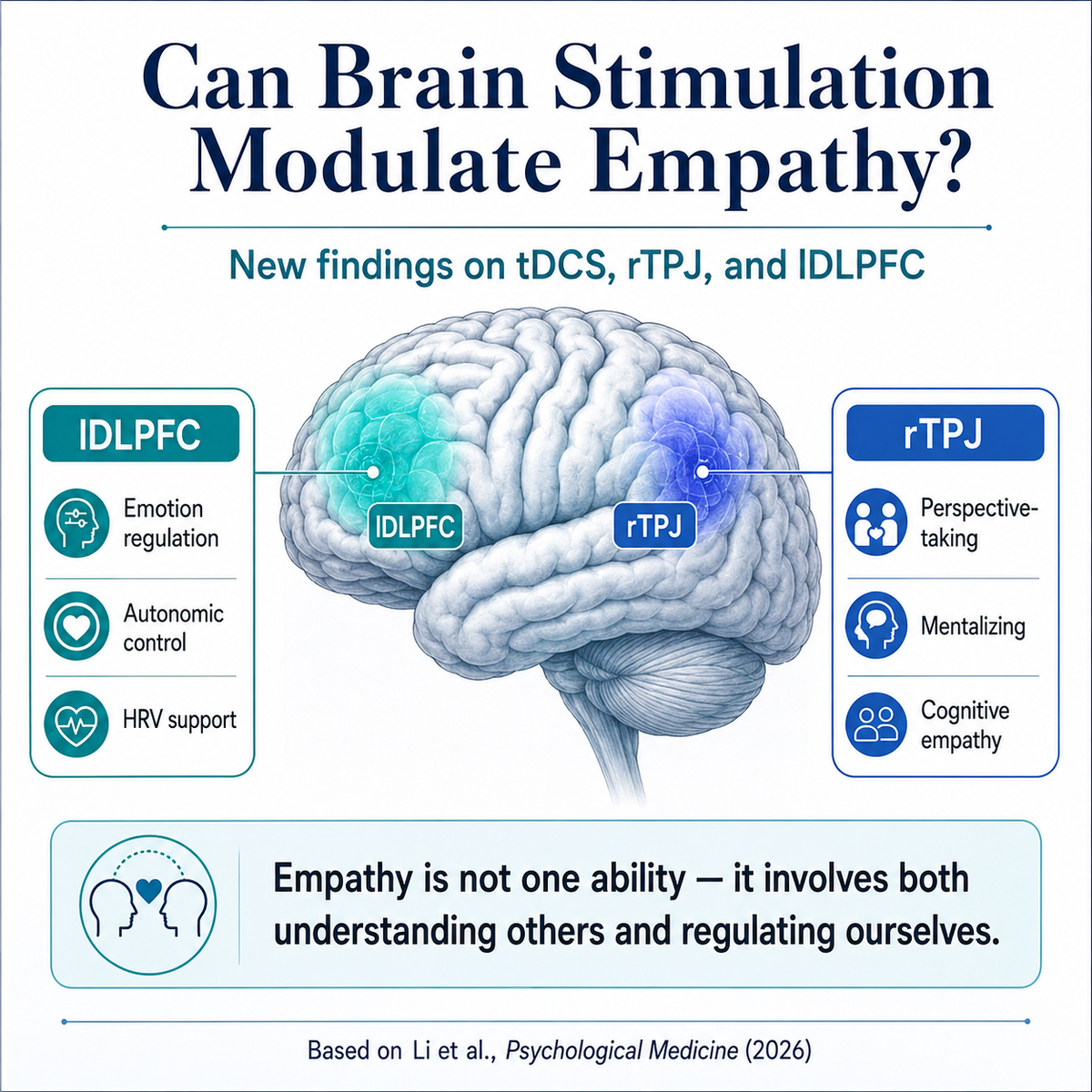
Can Brain Stimulation Modulate Empathy? New Evidence from tDCS Targeting rTPJ and lDLPFC
Introduction
Empathy—the capacity to understand and respond to others' emotions—is central to human social functioning. Yet, its neural underpinnings remain an active area of investigation in psychiatry and neuroscience. A recent study published in Psychological Medicine (2026) by Weichselbaum et al. examines whether transcranial direct current stimulation (tDCS) applied to specific brain regions can modulate distinct facets of empathy.
This article breaks down the study's methodology, findings, and clinical implications for mental health practitioners.
---
What Is Empathy, and How Is It Measured?
Empathy comprises multiple dimensions:
- Cognitive Empathy (CE): The ability to understand another person's mental state or perspective (also called "theory of mind").
- Emotional Empathy (EE): Sharing or resonating with another's emotional experience.
- Autonomic Empathy: Physiological responses (e.g., changes in heart rate variability, or HRV) when perceiving others' distress or emotional states.
Traditional self-report questionnaires (e.g., the Interpersonal Reactivity Index, or IRI) assess cognitive and emotional empathy. However, these subjective measures may not capture the full physiological and behavioral aspects of empathic responses. The current study integrates behavioral tasks, self-report scales, and heart rate variability (HRV) to provide a more comprehensive picture.
---
Study Design: Targeting Two Key Brain Regions
The Brain Regions of Interest
- Right Temporoparietal Junction (rTPJ):
- Known for its role in cognitive empathy and theory of mind.
- Involved in perspective-taking and understanding others' intentions.
- Left Dorsolateral Prefrontal Cortex (lDLPFC):
- Implicated in emotion regulation, executive control, and attentional processes.
- May modulate emotional responses and autonomic reactivity.
tDCS Protocol
- Anodal stimulation (excitatory) was delivered to either the rTPJ or lDLPFC in separate sessions.
- Sham stimulation served as a control condition.
- Participants completed empathy-related tasks and questionnaires both before and after stimulation.
---
Key Findings
1. rTPJ Stimulation Enhanced Cognitive Empathy
- Behavioral Task: Participants showed improved performance on tasks requiring perspective-taking and mental state attribution after anodal tDCS over the rTPJ.
- Self-Report: Subtle increases in self-reported cognitive empathy were observed, though these were less pronounced than the behavioral improvements.
Interpretation: The rTPJ appears to be causally involved in cognitive empathy. Enhancing its activity via tDCS can improve the ability to infer and understand others' mental states.
2. lDLPFC Stimulation Affected Autonomic Emotion Regulation
- Heart Rate Variability (HRV): Anodal tDCS over the lDLPFC was associated with changes in HRV during empathy-evoking stimuli.
- Emotional Empathy: Self-reported emotional empathy did not significantly change, but autonomic indices suggested improved regulation of emotional arousal.
Interpretation: The lDLPFC may play a modulatory role in managing the physiological aspects of empathic responses, particularly in regulating autonomic arousal when confronted with others' distress.
3. No Significant Changes in Trait Empathy
- Neither rTPJ nor lDLPFC stimulation produced lasting changes in trait-level empathy as measured by the IRI.
- This suggests that tDCS effects may be state-dependent and context-specific, rather than inducing long-term personality changes.
---
Clinical and Theoretical Implications
For Psychiatry and Psychotherapy
- Social Cognition Deficits:
- Conditions like autism spectrum disorder (ASD), schizophrenia, and certain personality disorders involve impairments in cognitive and emotional empathy.
- tDCS targeting the rTPJ could potentially serve as an adjunctive intervention to enhance perspective-taking skills in these populations.
- Emotion Regulation Difficulties:
- Disorders characterized by emotional dysregulation (e.g., borderline personality disorder, PTSD) may benefit from lDLPFC stimulation.
- Improved autonomic regulation could reduce hyperarousal and enhance therapeutic outcomes when combined with psychotherapy.
- Non-Pharmacological Intervention:
- tDCS is a non-invasive, relatively safe neuromodulation technique.
- It offers a potential alternative or complement to pharmacotherapy for enhancing social-emotional functioning.
For Neuroscience Research
- Causal Role of Brain Regions: Unlike correlational neuroimaging studies, tDCS provides causal evidence that the rTPJ and lDLPFC contribute to specific empathy components.
- Multidimensional Empathy: The study underscores the importance of differentiating cognitive, emotional, and autonomic empathy. Each may rely on distinct neural circuits.
---
Limitations and Future Directions
Limitations
- Small Sample Size: The study's sample was relatively modest, which may limit generalizability.
- Single-Session Design: Long-term effects of repeated tDCS sessions were not assessed.
- Individual Variability: Responses to tDCS can vary based on baseline empathy levels, brain structure, and other individual differences.
Future Research
- Multi-Session Protocols: Investigating whether repeated tDCS can produce more robust and lasting improvements.
- Clinical Populations: Testing tDCS in individuals with diagnosed social cognition or emotion regulation deficits.
- Combining with Psychotherapy: Exploring whether tDCS can enhance the efficacy of empathy-focused interventions (e.g., social skills training, mentalization-based therapy).
---
Practical Takeaways for Clinicians
- Empathy Is Multifaceted:
- When assessing empathy in clinical settings, consider cognitive, emotional, and physiological dimensions.
- Use a combination of self-report, behavioral tasks, and physiological measures when possible.
- Targeted Interventions:
- If cognitive empathy is the primary deficit, interventions (pharmacological, psychotherapeutic, or neuromodulatory) should target brain regions like the rTPJ.
- For emotion regulation challenges, the lDLPFC may be a more relevant target.
- tDCS as an Emerging Tool:
- While still experimental, tDCS shows promise as an adjunctive treatment for social-cognitive and emotional difficulties.
- Clinicians should stay informed about emerging research and consider referring patients to specialized centers offering tDCS as part of clinical trials.
---
Conclusion
The 2026 study by Weichselbaum et al. provides compelling evidence that tDCS can differentially modulate distinct components of empathy. Anodal stimulation of the rTPJ enhances cognitive empathy, while lDLPFC stimulation influences autonomic emotion regulation. These findings open new avenues for targeted neuromodulation interventions in psychiatry, particularly for conditions marked by social cognition deficits or emotional dysregulation.
As research in this field progresses, integrating tDCS with psychotherapy and pharmacotherapy may offer a holistic approach to enhancing empathy and improving interpersonal functioning in clinical populations.
---
References
Weichselbaum, H., et al. (2026). Differential effects of transcranial direct current stimulation over the right temporoparietal junction and left dorsolateral prefrontal cortex on distinct components of empathy. Psychological Medicine, 1–12. https://doi.org/10.1017/S0033291726000394
---
About the Author
Reza Eskandari, MD, Registered Psychotherapist is a CRPO-registered psychotherapist and internationally trained psychiatrist (PER verified by the RCPSC), and former Harvard Medical School postdoctoral fellow specializing in neuropsychiatry, translational mental health science, and evidence-based psychotherapy. He integrates cutting-edge neuroscience research into clinical practice to offer comprehensive, culturally sensitive mental health care.