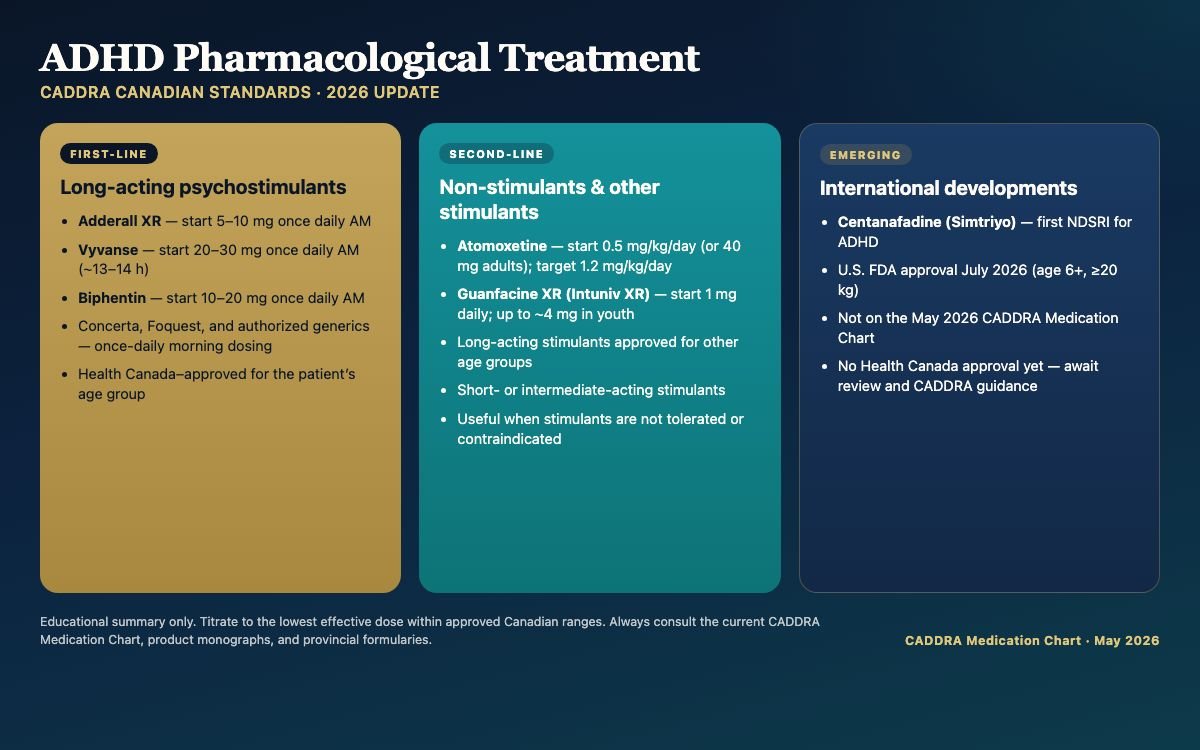
Attention-deficit/hyperactivity disorder is highly treatable, and Canadian clinicians rely on the Canadian ADHD Resource Alliance (CADDRA) guidelines and the regularly updated CADDRA Medication Chart as the primary national standard. The most recent CADDRA Medication Chart (May 2026) continues to classify long-acting psychostimulants as first-line therapy when they carry Health Canada approval for the patient’s age group. Recent international evidence, including a major 2026 dose-effect network meta-analysis and the U.S. approval of a new triple-reuptake inhibitor, can inform titration decisions within Canadian approved ranges and product monographs.
CADDRA Medication Classification
First-line
Long-acting psychostimulants (amphetamine-based and methylphenidate-based) that are Health Canada–approved for the patient’s age group. These agents have the strongest evidence and largest effect sizes for core ADHD symptoms.
Second-line
- Long-acting stimulants approved for other age groups
- Short- or intermediate-acting stimulants
- Non-stimulants: atomoxetine and guanfacine XR (Intuniv XR)
Pharmacotherapy should always form part of a comprehensive plan that includes psychosocial interventions.
Stimulants – First-Line Agents and Practical Dosing (CADDRA-Aligned)
Canadian long-acting options commonly used as first-line include:
Amphetamine-based
- Adderall XR — Starting dose typically 5–10 mg once daily in the morning. Titrate by 5–10 mg at weekly intervals. Maximum daily dose often listed as 30 mg in children and 20–30 mg in adolescents/adults (follow current product monograph and CADDRA chart).
- Vyvanse (lisdexamfetamine) — Starting dose commonly 20–30 mg once daily in the morning. Titrate according to response and monograph. Duration approximately 13–14 hours.
Methylphenidate-based
- Biphentin — Starting dose 10–20 mg once daily in the morning. Titrate by 10 mg weekly. Available in a wide range of strengths; maximum doses follow the product monograph (up to 80 mg in some contexts).
- Other long-acting methylphenidate formulations (e.g., Concerta, Foquest, and authorized generics) follow similar principles of once-daily morning dosing with titration guided by the monograph and clinical response.
A 2026 Lancet Psychiatry dose-effect network meta-analysis provides useful international context for titration: in children and adolescents, methylphenidate efficacy tends to plateau around 45 mg/day and amphetamines around 25 mg/day, with higher doses often increasing adverse-event discontinuations without proportional benefit. In adults, amphetamines show a plateau near 50 mg/day. These data support using the lowest effective dose within Canadian approved limits rather than automatic escalation to maximum labelled doses.
Non-Stimulants – Second-Line Options (CADDRA)
Atomoxetine
- Weight-based dosing. Typical starting dose 0.5 mg/kg/day (or 40 mg in adults).
- After 7–14 days, increase toward a target of 1.2 mg/kg/day (maximum usually 1.4 mg/kg/day or 100 mg).
- Full therapeutic effect may take several weeks. Swallow capsules whole.
Guanfacine XR (Intuniv XR)
- Starting dose 1 mg once daily (morning or evening).
- Titrate according to response and tolerability (evidence supports targets up to approximately 4 mg/day in children/adolescents).
- Must be swallowed whole. Monitor blood pressure and heart rate; taper gradually on discontinuation.
These agents are particularly useful when stimulants are contraindicated, not tolerated, or when substance-use concerns or certain comorbidities are present. Combination of a stimulant with a non-stimulant may be considered in partial responders under careful monitoring.
Newer Agents and International Developments
In July 2026 the U.S. FDA approved centanafadine (Simtriyo), the first norepinephrine-dopamine-serotonin reuptake inhibitor (NDSRI) for ADHD in patients aged 6 years and older (≥20 kg). It is not yet reflected in the May 2026 CADDRA Medication Chart and does not currently have Health Canada approval. Canadian clinicians should await Health Canada review and any future CADDRA guidance before considering it.
Key Clinical Principles Consistent with CADDRA
- Begin with a thorough assessment and clear treatment goals.
- Prefer long-acting first-line stimulants when appropriate.
- Titrate carefully to the lowest effective dose.
- Reassess regularly for efficacy, side effects, growth (in youth), and cardiovascular parameters.
- Integrate psychosocial interventions.
- Individualize based on age, comorbidities, patient preference, and provincial formulary coverage.
Conclusion
CADDRA continues to position long-acting psychostimulants as first-line pharmacological treatment for ADHD in Canada, with atomoxetine and guanfacine XR as established second-line options. Recent international dose-response data reinforce the importance of careful titration within approved Canadian ranges. Newer agents such as centanafadine expand the global landscape but require Health Canada approval and subsequent CADDRA consideration before routine Canadian use.
Always consult the current CADDRA Medication Chart, product monographs, and provincial formulary listings, and individualize treatment within a multimodal care plan.
Key References
- CADDRA – Canadian ADHD Resource Alliance. Guide to ADHD Pharmacological Treatments in Canada (Medication Chart). May 2026 update.
- CADDRA – Canadian ADHD Resource Alliance. Canadian ADHD Practice Guidelines, 4.1 Edition.
- Pharmacological interventions for ADHD: a systematic review and dose–effect network meta-analysis. Lancet Psychiatry. 2026;13(6):485-495.
- Ostinelli EG, et al. Comparative efficacy and acceptability of pharmacological, psychological, and neurostimulatory interventions for ADHD in adults. Lancet Psychiatry. 2025.
- FDA approval materials and phase 3 summaries for centanafadine (Simtriyo), July 2026 (for international context only).
This summary is intended for educational purposes and reflects evidence and Canadian guidance available as of August 2026. Clinical decisions must be based on the individual patient, current product labelling, the latest CADDRA resources, and applicable provincial regulations.