Introduction
Obsessive-Compulsive Disorder (OCD) is a serious mental health condition that affects millions of people worldwide. Despite its prevalence, OCD remains widely misunderstood, often trivialized as mere perfectionism or cleanliness. This comprehensive guide explores what OCD truly is, how it impacts daily life, and why evidence-based treatment is crucial for recovery.
What Is OCD?
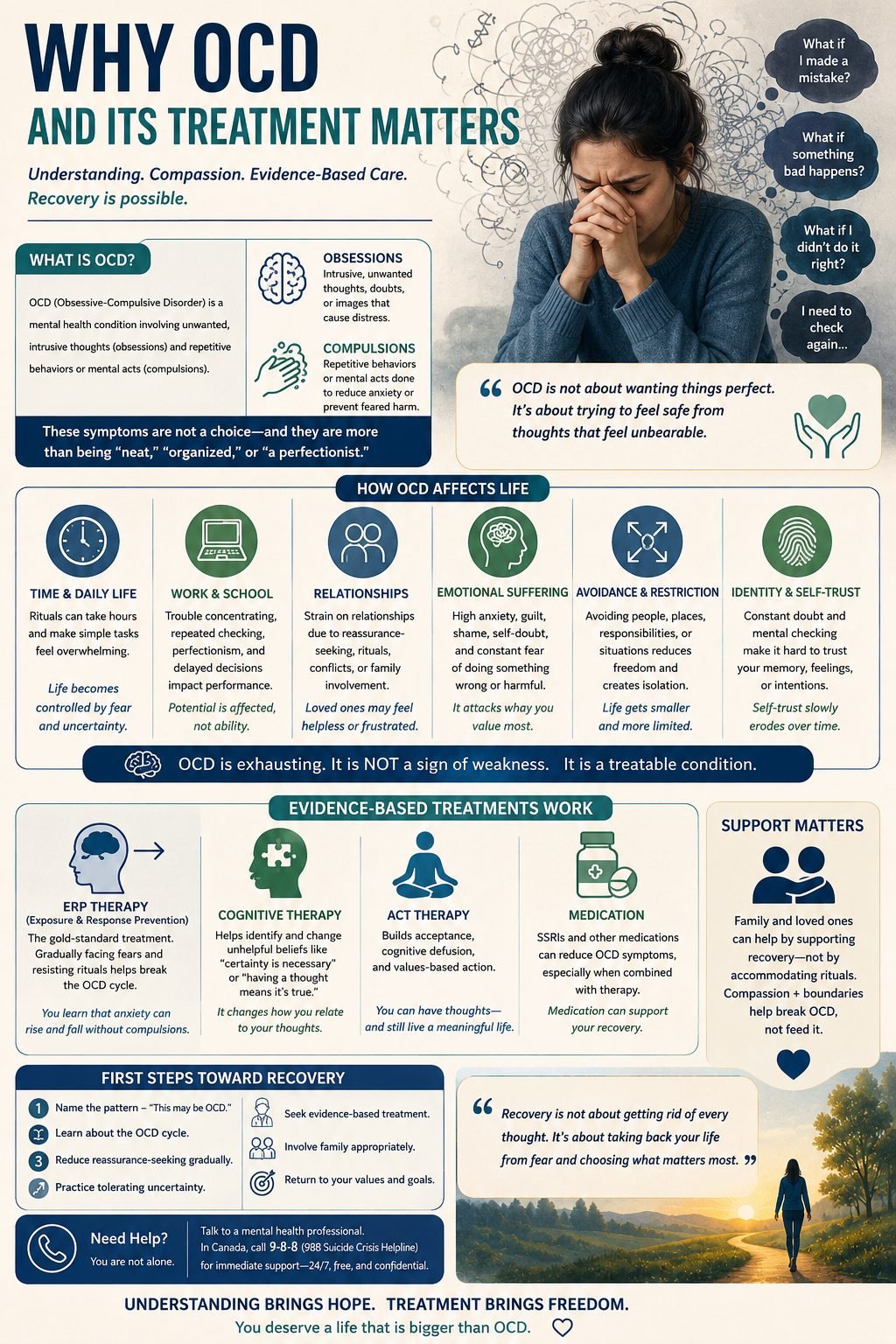
OCD is characterized by two main components: obsessions and compulsions.
Obsessions
Obsessions are unwanted, intrusive thoughts, images, or urges that cause significant anxiety or distress. Common obsessions include:
- Fear of contamination or germs
- Fear of causing harm to oneself or others
- Need for symmetry, order, or exactness
- Unwanted sexual or violent thoughts
- Fear of making mistakes or being irresponsible
- Religious or moral concerns
Compulsions
Compulsions are repetitive behaviors or mental acts performed to reduce anxiety caused by obsessions. Common compulsions include:
- Excessive cleaning or washing
- Checking and rechecking (locks, appliances, etc.)
- Arranging and organizing
- Counting or arranging in specific patterns
- Seeking reassurance repeatedly
- Avoidance of triggering situations
The OCD Cycle
OCD operates in a predictable cycle:
- Trigger: An obsessive thought, image, or urge appears
- Anxiety: The person experiences significant distress
- Compulsion: They perform a compulsive behavior to reduce anxiety
- Temporary Relief: The anxiety decreases briefly
- Reinforcement: The brain learns that the compulsion "works," strengthening the cycle
- Return: The obsession returns, often stronger, perpetuating the cycle
How OCD Affects Daily Life
OCD's impact extends far beyond the individual experiencing it, affecting multiple life domains:
Time & Daily Routine
People with OCD often spend hours each day engaged in compulsions. What should take 10 minutes (showering, getting ready) can take hours. This time consumption disrupts daily routines, sleep schedules, and overall productivity.
Work & Academic Performance
OCD can severely impact professional and academic functioning. Intrusive thoughts during important tasks, time spent on compulsions, and difficulty concentrating all contribute to reduced performance, missed deadlines, and career setbacks.
Relationships
OCD strains relationships with family, friends, and romantic partners. Loved ones may become inadvertently involved in compulsions (providing reassurance, accommodating avoidance), and the emotional burden of supporting someone with OCD can be significant.
Emotional Suffering
The constant cycle of obsessions and compulsions creates profound emotional pain. Anxiety, shame, guilt, and hopelessness are common emotional experiences for those with OCD.
Avoidance
To prevent triggering obsessions, people with OCD often avoid situations, places, people, or activities. This avoidance can become so extensive that it severely limits life opportunities and social engagement.
Identity & Self-Trust
OCD attacks the core of identity. People begin to doubt themselves, their values, and their character. The intrusive nature of obsessions can make individuals question who they really are.
Why OCD Is Often Misunderstood
OCD is frequently mischaracterized as:
- A preference for cleanliness or organization (it's not)
- A personality trait (it's a disorder)
- Something that can be controlled through willpower (it cannot)
- A condition that only affects certain types of people (it affects all demographics)
This misunderstanding leads to shame, delayed treatment-seeking, and inadequate support from others.
Why Treatment Matters
Without treatment, OCD typically worsens over time. The compulsions that temporarily relieve anxiety actually strengthen the disorder. Treatment breaks this cycle by addressing the underlying mechanisms of OCD.
Evidence-Based Treatments
Exposure and Response Prevention (ERP)
ERP is the gold standard for OCD treatment. It involves:
- Gradually exposing yourself to obsession triggers
- Resisting the urge to perform compulsions
- Allowing anxiety to naturally decrease (habituation)
- Building confidence in your ability to tolerate discomfort
Cognitive Therapy
Cognitive approaches help identify and challenge unhelpful thought patterns, such as:
- Overestimating threat
- Overestimating responsibility
- Intolerance of uncertainty
- Perfectionism
Acceptance and Commitment Therapy (ACT)
ACT focuses on:
- Accepting obsessive thoughts without fighting them
- Clarifying personal values
- Taking action aligned with values despite OCD
Medication
SSRIs (Selective Serotonin Reuptake Inhibitors) can reduce OCD symptoms by 40-60% in many people. Medication is often combined with therapy for optimal results.
The Role of Family and Loved Ones
Family involvement is crucial for recovery:
- Avoiding accommodation of compulsions
- Providing emotional support without enabling
- Learning about OCD to better understand the person
- Participating in family therapy when appropriate
OCD and Shame
Shame is a significant barrier to treatment. Many people hide their OCD due to embarrassment about their thoughts or behaviors. Understanding that OCD is a medical condition, not a character flaw, is essential for overcoming shame and seeking help.
When to Seek Help
Consider seeking professional help if:
- Obsessions and compulsions consume more than 1 hour per day
- OCD interferes with work, school, or relationships
- You experience significant distress
- Symptoms are worsening over time
- You're avoiding situations due to OCD
First Steps Toward Recovery
- Seek a qualified professional: Look for therapists trained in ERP or cognitive therapy for OCD
- Get an accurate diagnosis: Ensure proper assessment by a mental health professional
- Educate yourself: Learn about OCD and evidence-based treatments
- Be patient with yourself: Recovery is a process; progress takes time
- Build a support system: Connect with others who understand OCD
Conclusion
OCD is a treatable condition. With evidence-based treatment, most people experience significant improvement in symptoms and quality of life. If you or someone you know is struggling with OCD, remember that help is available and recovery is possible. The first step is reaching out to a qualified mental health professional who specializes in OCD treatment.
If this article resonated with you, I invite you to explore therapy as a space for growth, healing, and deeper understanding.
Book Appointment