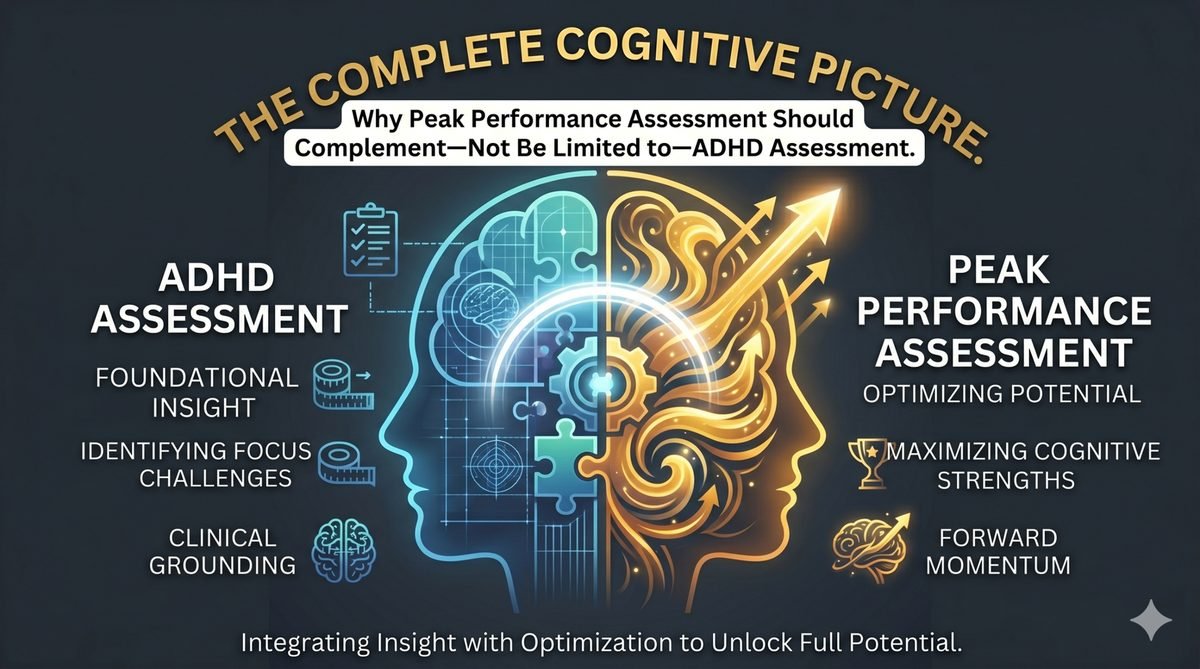
In clinical practice, I frequently encounter individuals who have undergone ADHD assessments, yet still struggle to understand why they aren't performing at their best. The truth is, an ADHD assessment—while valuable—captures only one dimension of human functioning. To truly understand an individual's potential and challenges, we need a broader lens.
This is where peak performance assessment becomes essential. It doesn't replace ADHD evaluation; it complements it, providing a comprehensive picture that leads to more effective interventions and better outcomes.
The Problem: Limitations of ADHD-Only Assessment
Traditional ADHD assessments are designed to identify specific symptoms: inattention, hyperactivity, and impulsivity. They excel at diagnosing ADHD, but they weren't designed to evaluate the full spectrum of factors affecting performance.
Consider what ADHD assessments typically miss:
- Cognitive strengths and weaknesses beyond attention (processing speed, working memory capacity, executive function nuances)
- Emotional regulation patterns that impact decision-making and relationships
- Stress response systems and their effects on daily functioning
- Environmental and contextual factors that influence performance
- Intrinsic motivation and goal-directed behavior separate from ADHD symptoms
- Sleep quality, physical health, and lifestyle factors affecting cognitive function
When we focus exclusively on ADHD symptoms, we risk missing other critical contributors to underperformance. An individual might have mild ADHD symptoms but severe anxiety, chronic sleep deprivation, or unrecognized learning differences—all of which profoundly impact their ability to perform optimally.
Understanding Peak Performance Assessment
Peak performance assessment is a comprehensive evaluation that examines the full range of factors influencing an individual's ability to function at their highest level. Unlike diagnostic assessments that focus on pathology, peak performance assessment emphasizes both challenges and strengths.
Core Components of Peak Performance Assessment
A thorough peak performance assessment evaluates multiple domains:
- Cognitive functioning: Processing speed, memory systems, executive functions, problem-solving abilities, and learning styles
- Emotional and psychological factors: Mood regulation, stress management, resilience, self-efficacy, and psychological barriers
- Physical and neurobiological factors: Sleep architecture, circadian rhythms, nutrition, exercise patterns, and overall health status
- Environmental and contextual elements: Work/study environment, social support systems, organizational demands, and life stressors
- Behavioral patterns: Habits, routines, time management strategies, and adaptive versus maladaptive coping mechanisms
Clinical Relevance
From a psychiatric and psychotherapeutic perspective, peak performance assessment provides a biopsychosocial framework for understanding human functioning. It recognizes that optimal performance emerges from the interaction of biological, psychological, and social factors—not from the absence of ADHD symptoms alone.
This comprehensive approach allows clinicians to develop more precise, individualized treatment plans that address the actual barriers to performance, rather than focusing narrowly on symptom reduction.
The Complementary Approach: Why Both Matter
The most powerful clinical outcomes emerge when ADHD assessment and peak performance assessment work in tandem. Each provides unique insights that the other cannot capture alone.
How They Work Together
Consider this integrated approach:
- ADHD assessment identifies core symptoms that may require medication, behavioral interventions, or accommodations
- Peak performance assessment reveals contributing factors that amplify or mitigate ADHD symptoms
- Combined data creates a complete picture showing how ADHD interacts with other performance factors
- Treatment planning becomes multidimensional addressing both ADHD symptoms and broader performance optimization
The Synergy Effect
When we understand both ADHD symptoms and performance factors, we can distinguish between:
- Performance issues caused by ADHD versus those caused by other factors
- ADHD symptoms worsened by poor sleep or stress versus primary ADHD pathology
- Situations where medication alone will help versus when comprehensive interventions are needed
- Individual strengths that can compensate for ADHD challenges
This nuanced understanding prevents both over-treatment and under-treatment, leading to more effective, personalized interventions.
Benefits for Different Stakeholders
For Individuals Seeking Help
- Comprehensive self-understanding: Gain clarity about all factors affecting your performance, not just ADHD symptoms
- Personalized strategies: Receive tailored recommendations based on your unique cognitive, emotional, and behavioral profile
- Empowerment and agency: Identify actionable changes you can implement immediately, beyond medication
- Long-term growth: Develop sustainable skills for continuous performance optimization throughout your life
- Reduced stigma: Understand challenges as opportunities for growth rather than deficits
For Clinicians and Mental Health Professionals
- Differential diagnosis: Distinguish ADHD from other conditions with overlapping symptoms (anxiety disorders, mood disorders, trauma responses)
- Treatment precision: Design interventions targeting actual performance barriers, not just assumed ADHD mechanisms
- Outcome measurement: Track progress across multiple domains, providing clearer evidence of treatment effectiveness
- Holistic care: Address the whole person, integrating psychiatric, psychological, and lifestyle interventions
- Collaborative treatment: Communicate more effectively with other healthcare providers using comprehensive assessment data
For Organizations and Educational Institutions
- Talent optimization: Identify and develop high-potential individuals more effectively
- Appropriate accommodations: Provide support based on comprehensive understanding, not just ADHD diagnosis
- Performance improvement: Address systemic and individual factors limiting productivity and engagement
- Prevention and early intervention: Identify performance issues before they escalate to crises
- Culture of excellence: Promote environments where individuals can achieve their full potential
Real-World Applications and Examples
The High-Achieving Professional
Sarah, a 32-year-old marketing executive, sought evaluation for suspected ADHD. Her assessment revealed mild ADHD symptoms—but peak performance evaluation uncovered the real culprits: severe chronic sleep deprivation, unaddressed perfectionism leading to decision paralysis, and work environment factors creating constant interruptions.
Treatment focused on sleep hygiene, cognitive-behavioral strategies for perfectionism, and environmental modifications. Stimulant medication played a supporting role, but the comprehensive approach addressed her actual performance barriers.
The Struggling University Student
James, a 20-year-old engineering student, had been diagnosed with ADHD in childhood. Despite medication compliance, he continued struggling academically. Peak performance assessment revealed executive function deficits beyond typical ADHD, significant test anxiety, and learning strategies poorly matched to his cognitive style.
Integrated treatment included medication optimization, executive function coaching, anxiety management techniques, and personalized study strategies. His academic performance improved dramatically—not from treating ADHD more aggressively, but from addressing the complete picture.
The Corporate Leader
Michael, a 45-year-old CEO, underwent ADHD assessment after years of suspecting he had it. While he met some ADHD criteria, peak performance assessment revealed that chronic stress, poor delegation skills, and lack of strategic prioritization were equally significant barriers.
Rather than starting medication immediately, we implemented executive coaching, stress management protocols, and organizational restructuring. These interventions improved his functioning more than medication alone would have achieved.
The Athlete Seeking Excellence
Lisa, a 28-year-old competitive athlete, wanted to understand why she consistently underperformed in high-pressure competitions despite excelling in training. Her evaluation showed no ADHD, but peak performance assessment identified performance anxiety, perfectionist thinking patterns, and suboptimal pre-competition routines.
Targeted interventions—including mindfulness training, cognitive restructuring, and routine optimization—transformed her competitive performance. An ADHD-only assessment would have missed these critical factors entirely.
Key Takeaways
- ADHD assessment is essential but insufficient for understanding the full picture of human performance and functioning
- Peak performance assessment provides comprehensive evaluation of cognitive, emotional, physical, environmental, and behavioral factors affecting optimal functioning
- The complementary approach prevents misdiagnosis and under-treatment by revealing the true complexity of performance challenges
- Individualized, multidimensional interventions are more effective than single-focus treatments when assessment data is comprehensive
- Both individuals and clinicians benefit from understanding the full spectrum of factors influencing performance, leading to better outcomes and sustained growth
Moving Forward: A Call to Comprehensive Assessment
As a psychiatrist and registered psychotherapist, I've witnessed countless individuals transform their lives when we move beyond narrow diagnostic categories to embrace comprehensive assessment. The question is not whether you have ADHD—it's whether you're functioning at your peak potential, and what's standing in your way.
Peak performance assessment doesn't diminish the importance of ADHD evaluation. Instead, it enriches it, providing context, nuance, and actionable insights that lead to truly effective interventions.
Whether you're an individual seeking to optimize your performance, a clinician looking to provide better care, or an organization committed to excellence, the complementary approach offers a path forward. It honors the complexity of human functioning while providing practical, evidence-based solutions.
If you're ready to move beyond simple diagnoses and discover what's truly possible for you, consider pursuing comprehensive assessment that includes both ADHD evaluation and peak performance analysis. The insights you gain may transform not just your performance, but your entire understanding of your potential.
Your journey to peak performance begins with understanding the full picture. Let's discover it together.